We’re passionate about good research, but more than that, applying it in the most effective ways—breaking down barriers and creating accessibility to treatments and interventions that will help families. That’s the promise of research: turning discovery into real change for the people who need it most.”
–Lynn Cole, DNP ’98N (MS), ’21N (DNP) Associate Division Chief, Division of Developmental & Behavioral Pediatrics
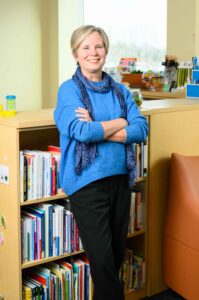
As associate division chief of the Division of Developmental & Behavioral Pediatrics at the University of Rochester Medical Center, Lynn Cole, DNP ʼ98N (MS), ʼ21N (DNP), believes deeply in the power of research. But its true value, she says, is about far more than uncovering new solutions. It’s about matching the right solution to the right patient at the right time.
“In our line of work, research is critically important,” says Cole. “Our patients are children and adolescents, and we want to ensure that the treatments we’re suggesting are the most effective and that families are getting the most out of them.”
That’s why accelerating these discoveries—and helping families gain access to the treatments and interventions that can have the greatest impact—lies at the heart of dedicated research funds, such as the Dr. Charles and Dr. Anne Francis Endowed Autism Research Fund.
“Yes, this is a research endowment, but it was intentionally designed to think about quality improvement in clinical care for children with autism and intellectual and developmental disabilities,” Cole says. “That means we have the flexibility to conduct research and also think about how we can implement that research into our care so that families can actually begin to feel that impact firsthand.”
The division, the largest developmental pediatrics center in Upstate New York, offers comprehensive care to children with developmental and behavioral disorders. As a result, its research efforts are not limited to autism alone. It encompasses a wide range of equally important topics, such as increasing access to care, bio-behavioral interventions like the efficacy of a gluten-free diet, support for caregivers under stress, and more.
Now, thanks to sustainable and reliable funding sources, like the Francis Endowed Autism Research Fund, groundbreaking research is being applied in meaningful ways, Cole says.
“What’s exciting is that these funds have given us the gift of time to dedicate to taking the evidence and applying it to our clinic. It’s allowed us to do really innovative projects that have led to improvements in care today,” she says.
“These funds are a powerful bridge between research and clinical care that is so important to the communities we serve,” Cole adds.
It’s that very belief—the inextricable link between research and community outcomes—that has Cole and her team focused on a new approach to research.
Now, through community-engaged research, community members are being consulted in the early stages of research, ensuring that the focus and the intended outcomes align with the needs of the individuals and families being served.
If there’s one thing I’ve observed over the course of my 20-year career, it’s that families are desperate to help their children. They want to give them the best developmental outcomes they can—and we want to help them do that.”