This physician, mentor, and philanthropist helped shape modern ophthalmology—and continues to guide the next generation of clinicians.
Dr. Donald A. Grover ’62, ’66M, ’73M (Res)
When Dr. Donald A. Grover ’62, ’66M, ’73M (Res) returned to the University of Rochester Medical Center’s Eye Clinic in 1974 to start his career, he was taking the first steps that would shape the future of ophthalmology in Rochester. At the time, the program was small, running on dedication more than space.
The waiting room was just 12 by 17 feet with 15 chairs, three exam rooms for three residents, and a single nurse and receptionist to keep it all moving. One exam room doubled as the ophthalmology library, and the area transformed at night into the lecture hall for Grand Rounds and Journal Club.
Behind that space stood a tiny operating room that also stored bacterial cultures. “Imagine that—surgery and bacterial specimens in the same room,” Dr. Grover recalls. That was, as he puts it, “pretty much the whole thing” when it came to resident education.
It was a modest setup, but it proved to be the foundation for something much larger. Under the leadership of Dr. Henry Metz, ophthalmology grew from a division within surgery to a full department, and later, under Dr. Steven Feldon, to the multi-story Flaum Eye Institute. Along the way, Dr. Grover became the department’s first director of residency training. He witnessed and helped drive and implement many of the changes.
On his very first day as a faculty member, clinic administrator Jean Curry handed him a small box. Inside was a plaque engraved with the words of inventor Charles F. Kettering: Take good care of your future because that is where you will spend the rest of your life.
“That plaque sat on my desk my entire career,” Dr. Grover says. “Today it occupies a prominent place in our breakfast area, where my wife, Karen, and I see it every morning. Its message, both practical and profound, influenced my approach to medicine and to life.”
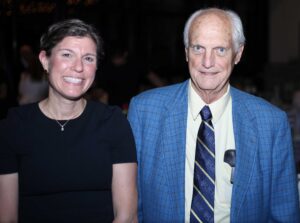
Dr. Rachel Wozniak, PhD, the Dr. Donald A. Grover ’62, ’66 (MD), ’73 (Res) and Karen L. Grover Director of the Ophthalmology Residency Program, and Dr. Grover
Investing in the future
The plaque’s message guided not only Dr. Grover’s career but also his vision for the generations who would follow. Even after his retirement in 2003, Dr. Grover remained committed to resident education. He and Karen established a fund to provide each incoming resident with the 10-volume ophthalmology set that forms the backbone of training. Over time, alumni contributions have expanded the fund to support additional aspects of education.
Their philanthropy has grown to include endowed professorships, estate gifts, and ongoing annual support. Among their most significant contributions are the Dr. Donald A. Grover ’62, ’66M (MD), ’73M (Res) and Karen L. Grover Distinguished Professorship in Ophthalmology, created to support the residency program’s director, and the Dr. Donald S. Grover ’35M Distinguished Professor in Medicine, established in honor of Dr. Grover’s father. The Grovers are also members of the George Eastman Circle, the University leadership annual giving society, and the Wilson Society, a group that honors those who have established life-income plans or named the University as a beneficiary. The couple’s generous support demonstrates their commitment to advancing the field by investing in people.
“I felt it was a privilege to practice medicine here, and a duty to collaborate and train future physicians,” Dr. Grover says. That sense of duty, he adds, was instilled by his father, a Rochester-trained physician from the Class of 1935.
Guidance for new physicians
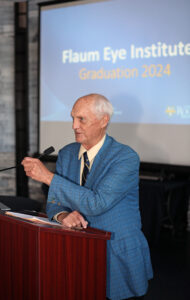
That same spirit of stewardship has shaped the advice Dr. Grover continues to share with young physicians. In June 2024, Dr. Grover returned to deliver the commencement address to ophthalmology graduates.
“Be mindful of the investment you have made in becoming a doctor,” he told them. “It takes 12 years of intense education, focus, and sacrifice to get there. Your medical license is not a right—it is a privilege. Guard it. Use it well. And never stop growing and improving.”
He also urged graduates not to forget those who made their success possible: “No one gets here alone. You owe it to them, the patients you care for, and the community you serve to do the best you can. But perhaps most of all, you owe it to yourself to be the best possible.”
Dr. Grover left them with a final reflection that has guided his own life: “If you strive to be ever better, doing all the good that you can do, you should have a happy, productive, and successful life. And that being said, the future will take care of itself.”
As a parting gift, he and Karen gave each graduate a replica of the plaque given to him on his first day—a reminder of responsibility, purpose, and hope for the future.
The human side of medicine
Even as he emphasizes professional responsibility, Dr. Grover also reminds physicians of something more fundamental—the human side of medicine. While technology has transformed ophthalmology—and improved care for millions—he offers a word of caution to current and future practitioners: don’t lose sight of the patient.
He recalls a conversation with an internist from a large public university who observed a troubling pattern among some medical trainees: “He told me some trainees sit at the computer, reading off software-generated questions. Sometimes, they don’t even know who the patient is.”
Dr. Grover believes technology should serve medicine, not replace its humanity. He underscores that “the most important person in the room is always the patient.” For him, advancing the department—through mentorship, leadership, and philanthropy—has always come down to supporting its people.
As professor emeritus, Dr. Grover continues to share his experience and advice with faculty, staff, students, and alumni. And as he reflects on a lifetime of giving, he emphasizes that generosity comes in many forms. “Some people give financially. Some give their time. Some give their ideas. The lucky ones do all three,” he says.
Words to live by
These principles have guided Dr. Grover’s career—and he offers them as inspiration to others.
“Take good care of your future because that is where you will spend the rest of your life.” —C. F. Kettering
“You cannot do all the good the world needs, but the world needs all the good you can do.” —adapted from Jana Stanfield
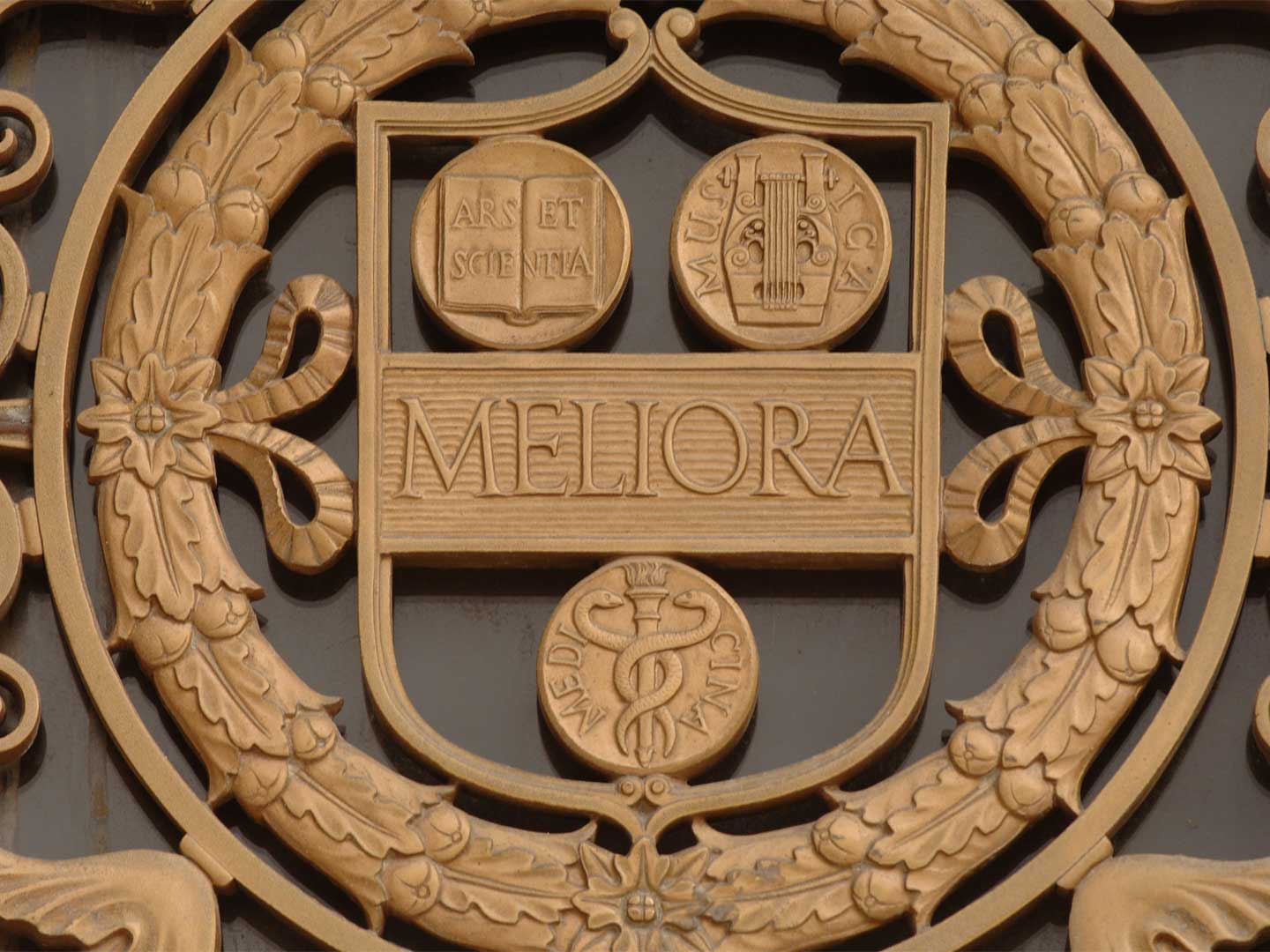
Embrace the University’s motto—Meliora—and always strive for “ever better.”
Then and now—Building ophthalmology at Rochester
1974: Three faculty—Dr. Albert C. Snell, Jr., Dr. Donald Zehl, and Dr. Donald Grover—six residents, and three exam rooms
1980s–1990s: Became its own department under Dr. Henry Metz; Dr. Grover served as first residency director.
2009: Under Dr. Steven Feldon, the department evolved into the Flaum Eye Institute
Faculty impact:
Dr. Donald Zehl: research that led to FDA approval of the soft contact lens
Dr. Henry Metz: suture innovations in pediatric strabismus surgery
Dr. Warren Hill: rewrote formulas for intraocular lens power in cataract surgery
Dr. Daniel Briceland: president of the American Academy of Ophthalmology
Today: Dozens of nationally recognized faculty, robust residency and fellowship programs, thousands of patients served annually, and satellite Flaum locations across western New York