Naveen Nataraj ’97
Chair, Board of Trustees Investment Committee

A gift to our endowment is a truly transformative act, securing our future in perpetuity. Your contributions provide enduring and essential resources that empower our students, support our distinguished faculty, fuel groundbreaking research, and advance our vital academic and clinical programs. In establishing an endowment, you create a legacy that resonates for generations to come, ensuring the continued excellence of the programs you cherish.
We are deeply grateful for your generosity. It sustains our mission and inspires all those we serve.
Topics on this page:
We are the makers of our future. At the University of Rochester, our commitment to Meliora is evident in this bold declaration to the world, a testament to our relentless pursuit of better opportunities, better outcomes, and a better future for all those we serve.
Our endowment plays a vital role in our ability to live this mission, providing the financial resources—in perpetuity— to support our most ambitious goals. Endowed gifts fund lifechanging scholarships, fuel groundbreaking research, and bring big ideas to life. They’re an investment in the people, programs, and priorities that make up this vibrant and dynamic community for discovery and innovation, and your support makes it all possible.
In the pages that follow, you’ll see our donors’ impact firsthand, not just in facts and figures, but through the lives their generosity has touched. There is not a corner of our campus that our endowment has not reached, and because of your partnership, we can look to the future with confidence, ready to seize our next great opportunity.
On behalf of a grateful community of students, patients, faculty, and staff, thank you for your meaningful investment in our future.
Sincerely,

Sarah C. Mangelsdorf
President and G. Robert Witmer, Jr. University Professor
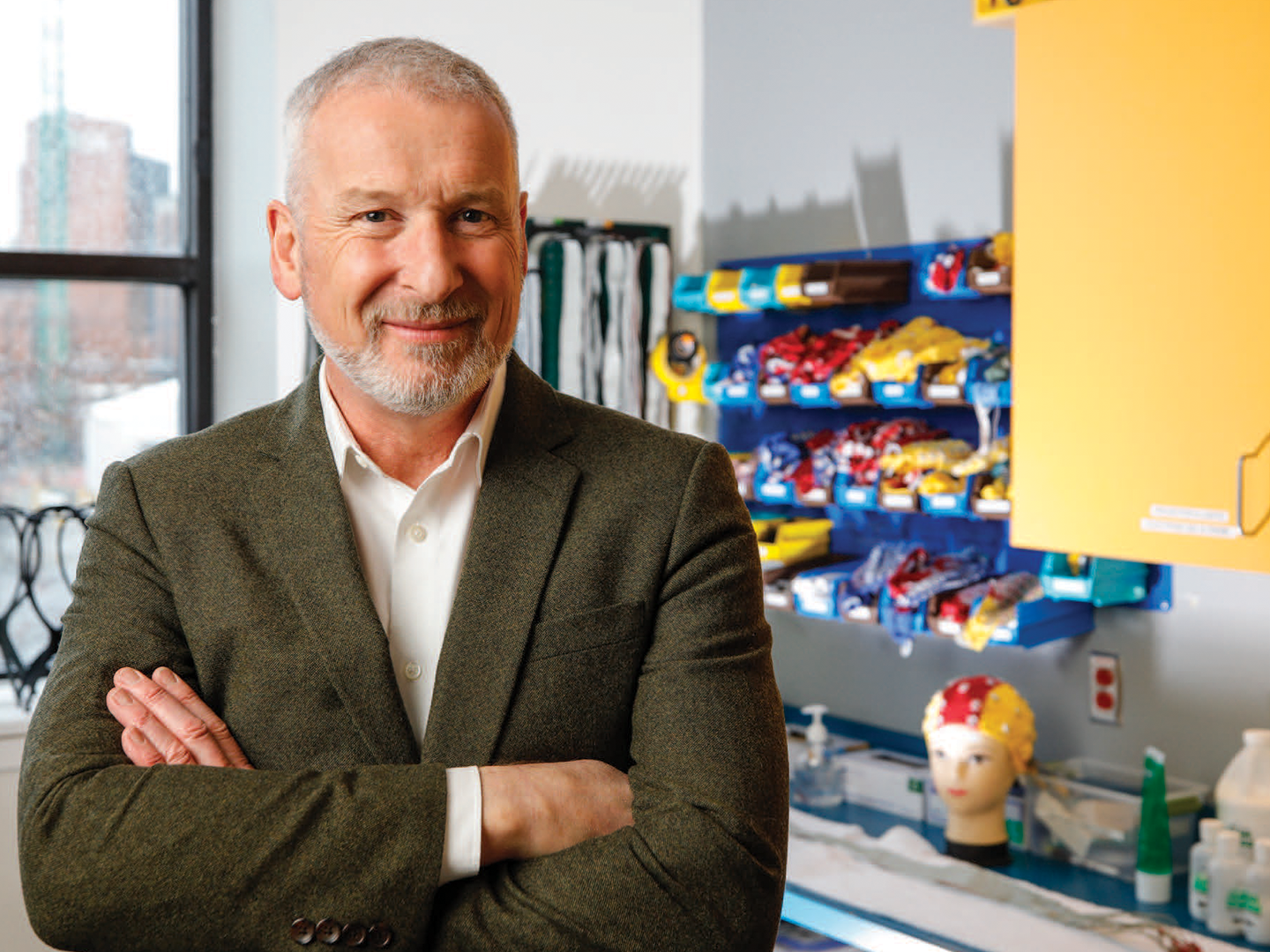
Research Director, The Ernest J. Del Monte Institute for Neuroscience
Kilian J. and Caroline F. Schmitt Chair in Neuroscience
Well, certainly the offer to join as the inaugural directorvof the Del Monte Institute was incredibly attractive time—it was a fantastic opportunity to be part of a great university with an exceptional history. In my previous role, I did a lot of thinking about the way we do sciencevin a university system, because really, it’s one that’s built for individuals to create their own labs and work on their own problems. I had this feeling that we were
missing part of the equation, that interdisciplinary teams would be able to ask and answer bigger questions. To do that, you need to be able to pull together teams in bigger centers—and that’s what was happening at Rochester. All the ingredients were there to launch a new part of my career.
The tools that are available to us as researchers now—from the kinds of equipment and technology at our fingertips to the sheer computing power that allows us to churn through massive data sets—it’s a completely different world we work in, even compared to 20 years ago.
One of the areas where there are great strides being made is at the intersection of neuroscience and genetics. Our ability to use vectors to do gene editing is allowing us to tackle diseases in a way that we couldn’t for a long time. Many of the diseases we’re
focused on here are rare, monogenetic diseases, and now, we can build models of these diseases in mice.
What does this mean? We can get into even greater detail, giving us the ability to bring new treatments into clinical trials. Already there have been completely exception successes on this front—diseases that have afflicted us for centuries. I have real hope that we can reverse these problems.
Oftentimes, individuals with intellectual and developmental disabilities have really complex health issues – pulmonary, cardiac, movement. They’re a lot sicker than individuals without an intellectual and developmental disability, and that presents a very specific healthcare challenge. We want to bring solutions to these people; we want to look for new
treatment therapies and possible cures. So how do we deliver a standard of care that a neurotypical person would expect? The way forward is for us to find a solution for these folks to create easier access to healthcare. I will say, we do really well with those we can see, but there are so many more on our waiting list. This gift will allow us to create
more space, bring in more providers, and train future providers with the specialized skills they need to care for this population of patients.
Mr. Golisano’s commitment is more than a transformative gift—it’s the recognition of decades of work that have gone into building a world class organization. People have worked hard to generate the best standards of care, and this gift recognizes the role that IDD clinics play in establishing and delivering that level of care.
I must say, it’s a bit like winning an Oscar for anacademic; it’s the last major honor and recognition of your work. But more than anything else, it provides money for my lab to pursue the big ideas that might change the course of these diseases—to “swing for the fences.” Federal funds are inherently conservative because you need to produce results that prove your hypothesis. If you know it needs to work, you find yourself pursuing safer and safer projects. Funds from an endowment operate in a different way. There’s an expansiveness that allows you to take risks.
To me, Meliora is about striving for excellence—the search for the truth—which is also the beauty of science. When an experiment doesn’t work, it’s natural to feel disappointed, but it’s not a disappointment at all. The world works the way the world works. Our job is to come up with an idea and test that. Whether we’re right or wrong, we’re adding to the knowledge on that particular topic. As long as we’re pursuing knowledge, we’re on the right path. Building a skill set that is rooted in rational thought, logic, reason—these are the things a great university provides for a young mind.
My hope is that if we train enough rational people, we’ll end up with a much more rational world. That’s what gets you to ever better.”

Student Leader, MobilEyes at Flaum Eye Institute
Regional Student President, American Medical Women’s Association
Recipient of the Levitan Family Endowed Scholarship
Growing up, I always wanted to be a doctor, but in China, as a woman, I didn’t think it was possible. Before attending college in Hong Kong, all of my education had been in a small village in China. Receiving a scholarship to study in Hong Kong, this was the first time I was exposed to a more diverse and inclusive environment.
Three and a half years into my undergraduate studies, my mom suggested that I apply for transfer to the U.S. where it might be easier for women to be doctors. I applied and was accepted at the University of Wisconsin-Madison, where I majored in biochemistry and economics. It was there I got involved in ophthalmology research, an area I found to be closely tied to both physical and mental health. Sight is a precious thing; when you have it, you don’t realize howvaluable it is. But, when you begin to lose it, it can be detrimental to your holistic health and wellbeing.
After graduation, I took a full-time job at Johns Hopkins, where I was exposed to both the community health and research sides of medicine. It was then I knew I wanted to go to medical school.
For international students in America, it’s so hard to get into medical school—there are only a couple hundred students accepted per year. That’s what makes the Levitan Family Endowed Scholarship for international students at the University of Rochester so special. Dr. Levitan’s belief—that the best environment for learning is one that embraces the experiences and perspectives of students from international cultures—is really inspiring. It’s the kind of holistic, global lens to medicine that I wanted to be a part of. When I finally visited, I was so impressed by how integrated the science and the clinical care are.
I also felt like everyone was so inclusive and supportive. There is often competition between medical students because we are going to apply for the same schools, and sometimes people are not very kind to each other. But here I could see that your peers really want you to do better, and really want you to achieve your goals, and they will cheer for what you achieved.
For the longest time, I thought I wasn’t good enough, and there were so many years of dreaming of being a doctor, but it didn’t seem like I could do it, especially as a person who speaks English as a second language in a foreign country.
Here, in Rochester, I’ve been able to connect with people who share the same ambition in things such as community health or being a minority in healthcare. So even though I doubted I could do it, seeing people who are several steps in front of me is very affirming. Seeing their progress makes me believe that I can also do it.
It was transformative for me because it alleviated significant financial stress for me and my family.
To receive this award from Dr. Levitan, someone who is a very esteemed physician and wants to support international students, is especially meaningful because it means the medical community here sees international students as a valuable asset.”
My parents constantly express their gratitude to Dr. and Mrs. Levitan—they really want to visit them sometime if they can. Dr. Levitan is now a role model for me too. When I become a physician, I want to support students in their education, just as the Levitans did for me.
I feel seen by the University and the medical communities. Being a medical student at the
University of Rochester makes me feel like I’m capable of more than what I imagined. The faculty, my peers, they’re encouraging me to make progress and achieve more and improve myself. I’m so lucky to be in such an inclusive environment. And I feel I’m even more determined to be a better version of myself.
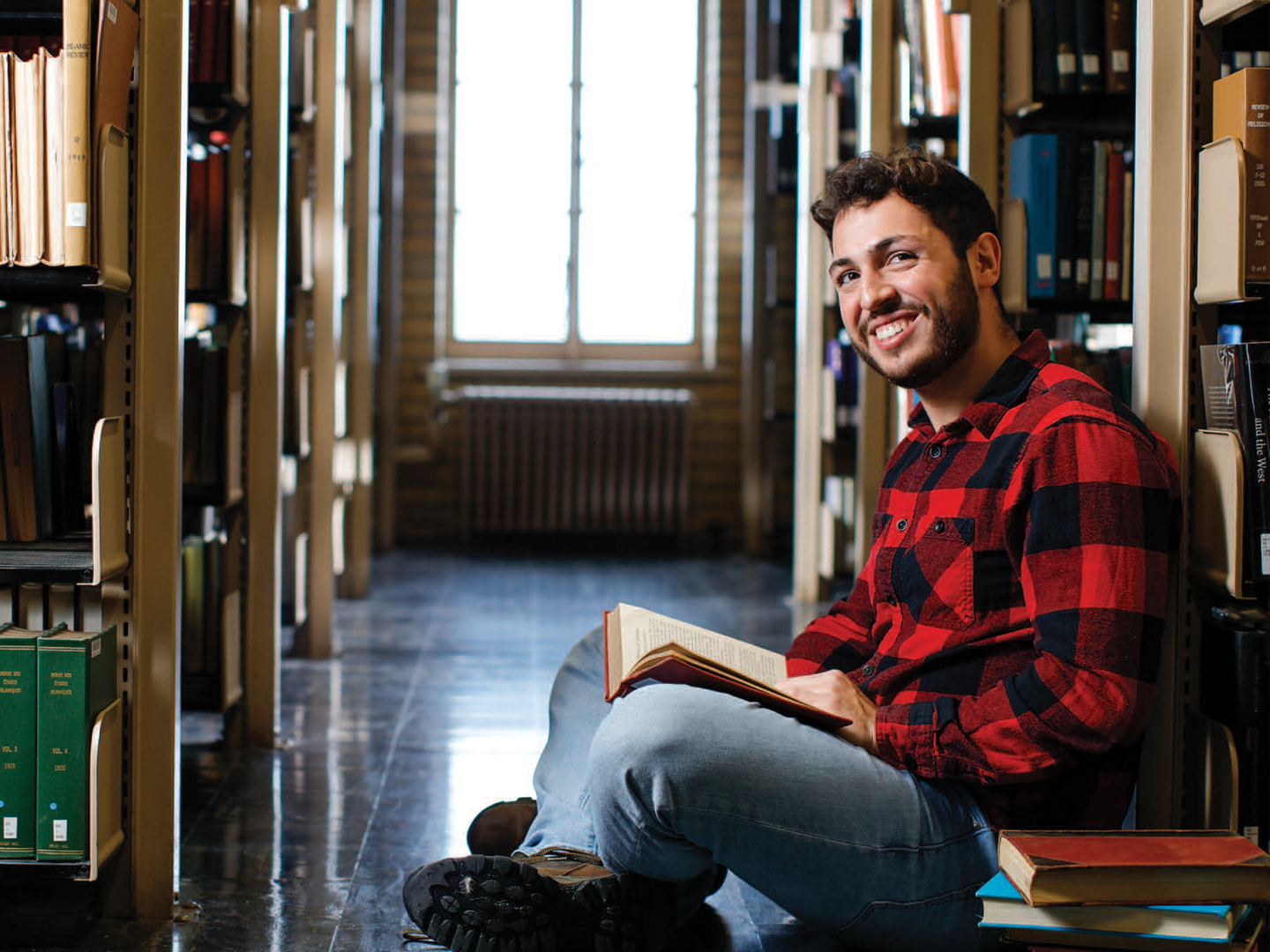
Majors: Political Science and Language, Media, Communications
Minor: Business
Recipient of the Koller/Diez Centennial Scholarship
I applied to the University of Rochester right out of high school and got in, but ended up going to Monroe Community College (MCC) for two years to save some money. I then decided to transfer to UR because it was a smaller college than the others I was looking at. It seemed like a community I could really get involved with. I also grew up in Rochester and knew I would be comfortable in the area and continue my community involvement. The political science program here really interested me, not just because it’s highly ranked,
but because it was different from the other poli-sci” “programs that I looked at. It’s very STEM based—I enjoy reading and public speaking, which a lot of liberal arts colleges tend to focus on, so I thought it would be good to build some other skills at a university that has a more analytical approach.
I was talking with a friend about the topic of careers and initially thought I was between acting, psychology, writing, or something in history, though I didn’t want to be a teacher. My friend suggested, “Why don’t you go into politics?” He was planning on a career in politics at the time, and his argument resonated with me.”
“He said, “In politics you have to understand people like a psychologist, present yourself like an actor, have a solid knowledge of history, and if you like, you can write a book or so along the way.”
That week I made a decision that every day I would listen to an hour of political commentary to see if I enjoyed it, and I never stopped. Soon I was able to relate politics to a wide variety of issues we discussed in school, finding ways to share my opinions and ideas with others—even those who might disagree with me.
In the end, I want to put my skills to use in a way that matters, and I believe politics is that outlet for me. Long term, I hope to do this as a legislator like a congressman or senator. Right now, the next step is pursuing a law degree, which I plan to do the semester after graduation.
Last year I joined Cru, which is an interfaith organization, and Model UN, which was something I did at MCC. And this year I joined College Republicans, which has really helped me meet people in my field.
Last spring, I completed my first internship in the House of Representatives for our local Congressman Joe Morelle. I had the chance to focus on constituent service, which I was already somewhat familiar with given my extensive employment history in customer service, but it was so much more than that. I learned quite a bit about democratic representation, and what the daily life of a congressman actually looks like. I also walked away with a much deeper connection and knowledge of the Rochester community.
Without scholarships I wouldn’t be able to go to college—that’s just a fact. One of the greatest struggles with college was the cost. It was a constant conversation in my household—how to pay for it and how much debt I would have when I finished. I’ve paid for college completely out of pocket, working the entire time, and my intended career path isn’t exactly known for high earnings and job stability.
This scholarship means that I can pursue a college education without incurring an absurd amount of debt, which might have taken decades to pay off.”
For me, scholarship support helps open the door to attending law school down the road, which might enable greater career success and economic mobility.
To me, it’s about creating a culture that is always pushing people to be better academically, personally, emotionally, and socially. It’s less of a destination and more of a journey. Everything we do is to try to become a better version of ourselves in different ways. You’re always working towards that.
Senior Vice President and Chief Investment Officer
When I first arrived, the University was spending its endowment funds at an unsustainably high rate. The number of gifts to endowed funds were far below peer metrics, and investment performance was below the level needed to sustain the University’s finances. Some alumni and faculty still remember those challenging years in the 1990s. Since the early 2000s, University leaders—together with the team in the Investment Office—have worked very hard to remedy all these challenges. Investment performance is now at a level that allows steady growth in endowed support, and it is competitive among peers.
Endowment spending balances current need with support for future generations of our faculty and students. The compounding of gifts to endowed funds over the last 25 years has made the largest difference.
The last campaign raised more than $600 million of new endowment funds, which grew to $1 billion through investment performance.
These new endowments provide $50 million per year of spending to support the core academic budget. One example of that academic support is named faculty positions, such as professorships. Our school deans say it is much easier to recruit and retain top faculty with named endowed funds that support the faculty member’s compensation. The University added 190 endowed professorships during the last 20 years. This is tremendous progress in this area. One vital area where we still remain below our peers is in the number of endowed scholarships. I’m optimistic our next campaign will help address that.
Many people harbor a belief that college and university endowments are one big pot of money. That is incorrect. There is no singular endowment at any educational institution. The University of Rochester’s endowment consists of approximately 3,000 different funds, each with a purpose specified by the donor or the Board of Trustees. We can’t simply say, We’re going to take the endowment and spend it on something new. It’s impossible to do that without violating the law. Funds have permanent designations established by a contract. Once an endowed fund is established, its purpose cannot change without donor approval or significant undertaking.
I think of the Investment program as an orchestra and I’m waving the baton as the conductor of that orchestra. I don’t think conductors of orchestras should take credit for the performance of the players — and there are a lot of players and stakeholders here. But I was proud to be the conductor for 25 years. I’m not saying this out of modesty—there’s actually very little I can do alone. I can’t force people to give money. I can’t change the student demand, or the number of faculty members. But I can bring those things to the attention of the right people, the Trustees, the President, and our advancement team. So I guess I am most proud of just being the conductor and being able to work with some really
wonderful people who actually did the work.
I like the University’s motto, “Meliora,” because it speaks to the betterment of our University. Perpetual support from endowed funds plays a role in that betterment. I hope the University will continue the growth in the perpetual support achieved over the past 25 years.
I also like to say the University of Rochester consists of meliorists—people who are constantly chipping away and never give up. They make progress through the continued human effort. If you are reading this, you are likely a meliorist. My colleagues and I think about the Investment Office in that way. Just continue to work on it. Keep pushing it ahead.
It’s been my honor to serve as your Chief Investment Officer for the past 25 years, a time when we have shown that progress is possible at the University and that we as humans can make it happen.
What we want is steady growth in spending and generational equity. If you overspend on today’s generation, you’re shortchanging the future generation.”
Endowment funds are pooled together for investment purposes and are managed by many of the world’s most well-regarded investment firms. Investment performance of these firms, combined with giving by generous donors, helps to ensure the continued financial viability of the University.
The University of Rochester’s endowment funds, now numbering more than 3,000 with a value of more than $2.9 billion, perpetuate a key source of revenue for the University. Approximately $130 million is expended each year from these endowment funds for faculty support, student scholarships, and programs.
The Investment Committee and the University’s Board of Trustees take a long-range view of the endowment to ensure support of both current and future generations of our faculty and students. The endowment’s well-diversified investment portfolio and prudent spending policy serve to balance the present with the future.
On behalf of our students and faculty, we thank you for your support.
Naveen Nataraj ’97
Chair, Board of Trustees Investment Committee
Geoffrey Berg
Senior Vice President and Chief Investment Officer
As of June 30, 2024 (fiscal year-end 2024), the University of Rochester’s Long-Term Investment Pool (LTIP) was valued at $3.5 billion. Endowed funds from the University’s programs represent approximately $2.9 billion of the LTIP.* Each fund benefits from scale and diversification of the LTIP. The University is one of 60 colleges and universities in the United States with an endowment of more than $2 billion.
The LTIP outperformed the benchmark (80% stocks and 20% bonds for the 10-year period.) Rochester’s ten-year net annual return was 7.4% versus 7.3% for the benchmark. The five-
year average net annual investment return was 8.7% versus 9.0% for the benchmark. During the fiscal year ending June 30, 2024, the LTIP return was 9.5%, compared to the benchmark return of 16.5%.
*Other funds held in the LTIP include trusts, annuities, supporting organizations, foundations, and reserves.
(dollars in billions)
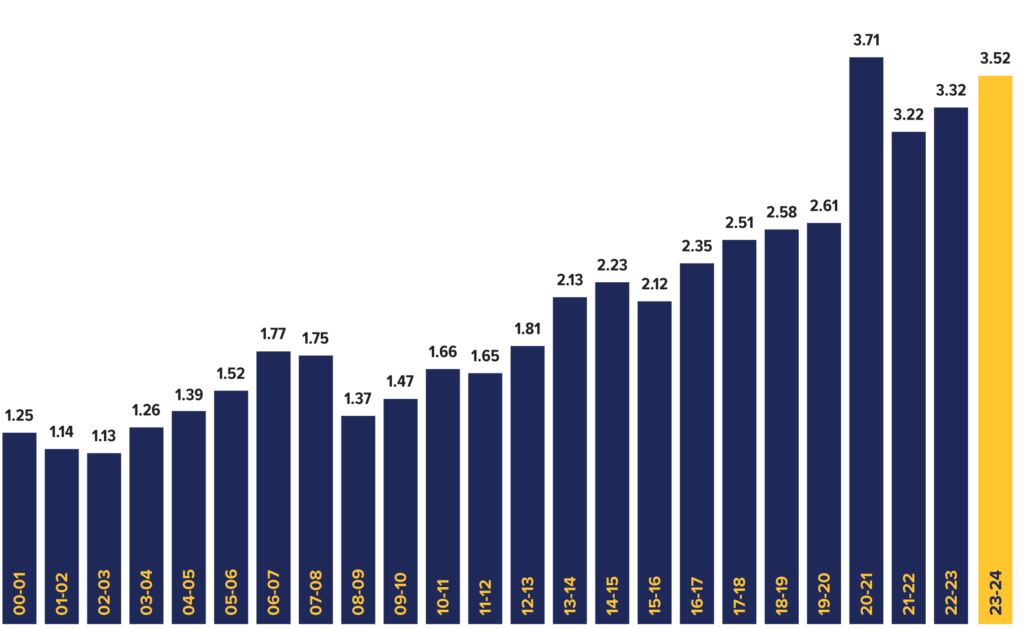
| Year Period | Value |
|---|---|
| 2000-01 | 1.25 |
| 2001-02 | 1.14 |
| 2002-03 | 1.13 |
| 2003-04 | 1.26 |
| 2004-05 | 1.39 |
| 2005-06 | 1.52 |
| 2006-07 | 1.77 |
| 2007-08 | 1.75 |
| 2008-09 | 1.37 |
| 2009-10 | 1.47 |
| 2010-11 | 1.66 |
| 2011-12 | 1.65 |
| 2012-13 | 1.81 |
| 2013-14 | 2.13 |
| 2014-15 | 2.23 |
| 2015-16 | 2.12 |
| 2016-17 | 2.35 |
| 2017-18 | 2.51 |
| 2018-19 | 2.58 |
| 2019-20 | 2.61 |
| 2020-21 | 3.71 |
| 2021-22 | 3.22 |
| 2022-23 | 3.32 |
| 2023-24 | 3.52 |
Rochester’s portfolio is divided into 45% traditional publicly traded assets—stocks and bonds—and 55% non-publicly traded investments, such as private equity, hedge funds, and real estate, referred to as “alternative investments.” This approach has ensured growth during economic expansions and capital preservation in economic downturns, with
volatility far below the benchmark.
Major asset classes generated the following performances in fiscal year 2024 (net of fees):
Publicly traded equity generated a net return of 14.8% compared to 19.4% for the global stock benchmark.
Alternative investments generated a net return of 7.3%. Hedge funds returned 12.4%, private equity funds returned 4.6%, and real asset funds returned -5.3%.
Fixed income and cash returned 6.4% compared to the 4.9% return for the bond/cash benchmark.
as of June 30, 2024:
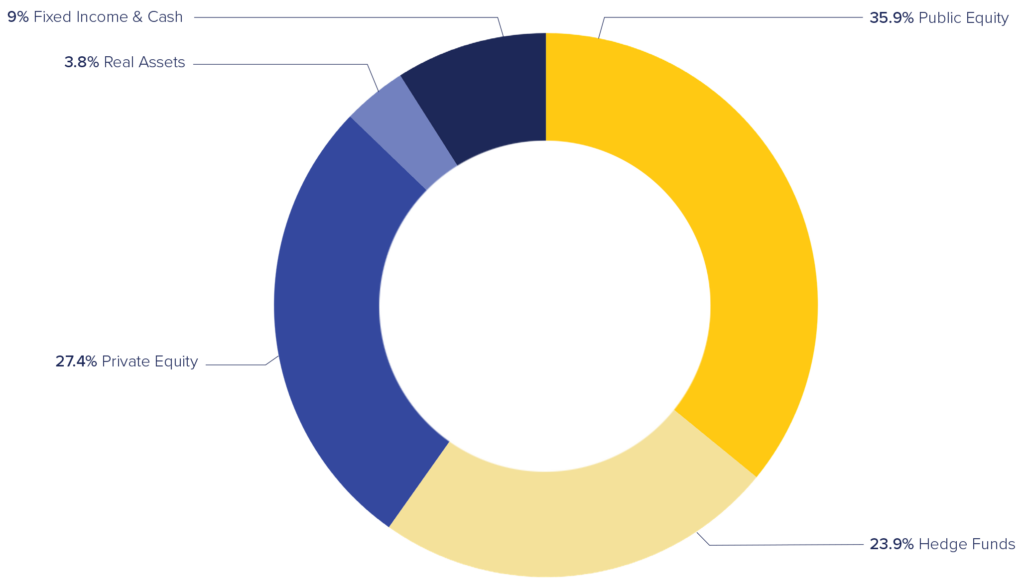
35.9% – Public Equity
23.9% – Hedge Funds
27.4% – Private Equity
3.8% – Real Assets
9% – Fixed Income & Cash
The University of Rochester Medical Center endowments comprise the largest component of the LTIP. Arts, Sciences & Engineering and the Eastman School of Music account for the next two largest components. Endowments of the Simon Business School, Warner School of Education, and the Memorial Art Gallery collectively represent about 6% of the LTIP. Approximately 6% of the LTIP represents unrestricted gifts that are designated by the Board of Trustees as permanent endowment for support of education.
The University’s endowment spending policy ensures a growing and sustainable source of revenue for the University’s departments, schools, divisions, and programs, as well as intergenerational equity for all endowment accounts. It also aligns with our peers.
The policy contains both inflation-based and market-based components. Spending rates will generally range between 4% and 6% of the 20-quarter rolling average market value
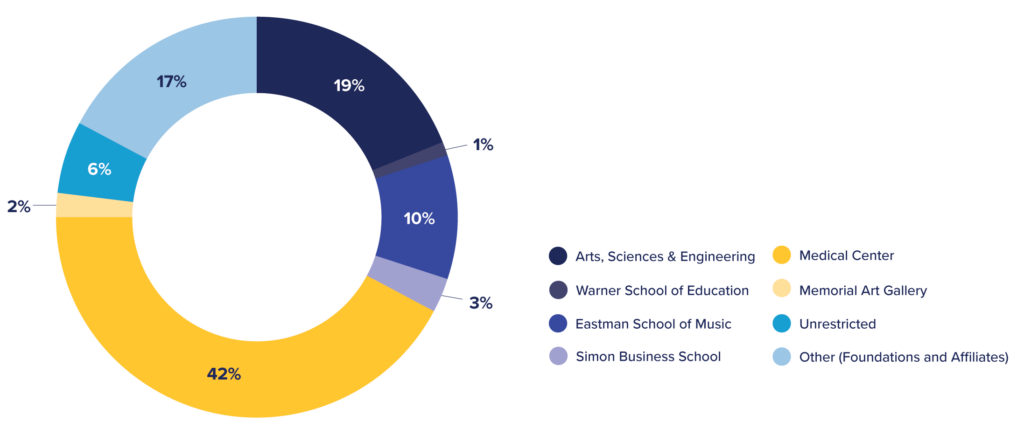
19% – Arts, Sciences & Engineering
1% – Warner School of Education
10% – Eastman School of Music
3% – Simon Business School
42% – Medical Center
2% – Memorial Art Gallery
6% – Unrestricted
17% – Other (Foundations and Affiliates)
(largest component of the LTIP) | Dollars in thousands
| Year | Endowment Market Value | Net Return | Spending |
|---|---|---|---|
| 2024 | $2,989,014 | 9.5% | $127,178 |
| 2023 | $2,822,698 | 6.9% | $117,535 |
| 2022 | $2,739,187 | -11.6% | $118,928 |
| 2021 | $3,194,900 | 41.7% | $114,314 |
| 2020 | $2,328,140 | 3.7% | $110,779 |
| 2019 | $2,317,560 | 6.3% | $108,053 |
| 2018 | $2,257,557 | 10.0% | $102,171 |
As of January 1, 2025
The University’s Ethical Investment Advisory Committee (EIAC) consists of faculty, staff members, and undergraduate and graduate students. EIAC’s purpose is to identify areas of potential concern and investigate the consonance of the University’s investment policies and values. Where appropriate, EIAC makes recommendations to the Board of Trustees’ Investment Committee regarding particular investments, communications, and proxy votes.
Donor Engagement Office
Larry and Cindy Bloch Alumni and Advancement Center
P.O. Box 278710 | Rochester, NY 14627 | (585 ) 273 – 2700
If you have questions about this report, please contact Leslie Zornow, Executive Director of Donor Engagement leslie.zornow@rochester.edu